
dejar un mensaje
Si está interesado en nuestros productos y desea conocer más detalles, deje un mensaje aquí, le responderemos lo antes posible.
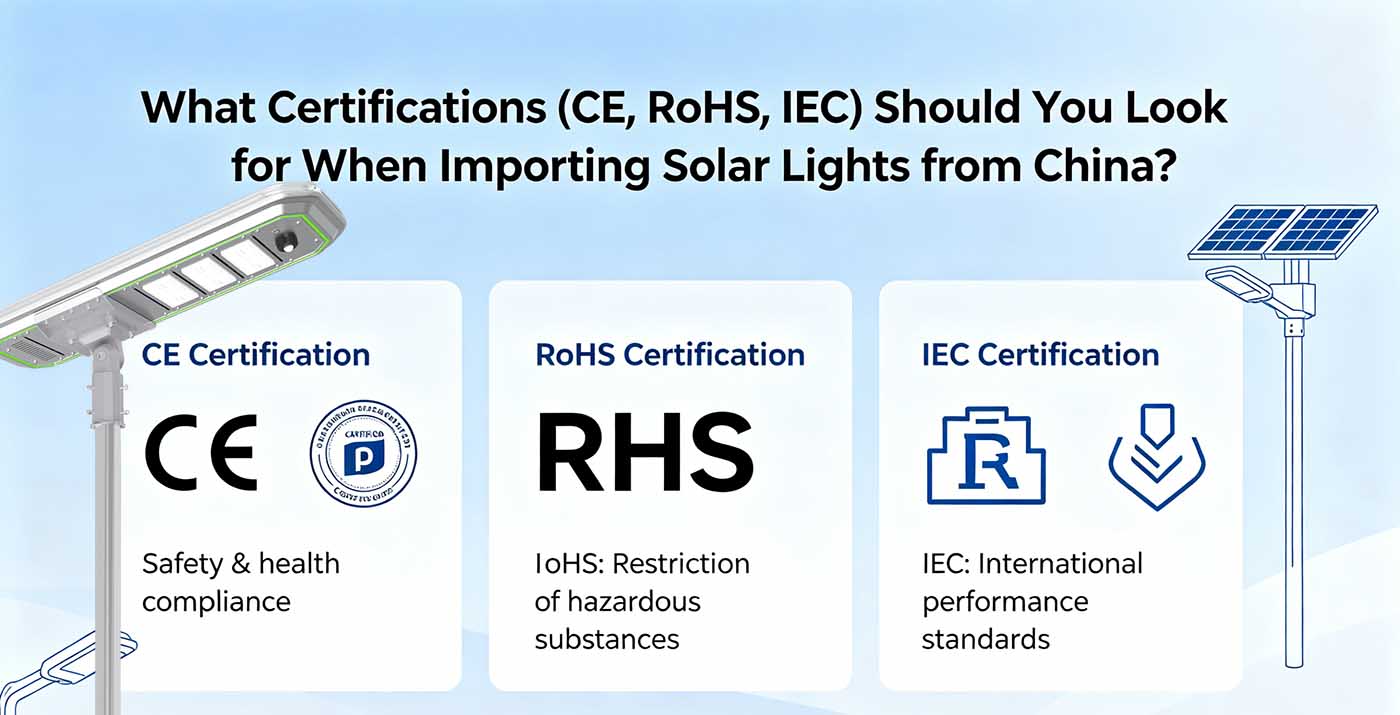
Marcado CE: Obligatorio para todas las importaciones del mercado de la UE/EEE.
La certificación CE es una marca legal obligatoria para todos los productos eléctricos vendidos en la Unión Europea, que acredita que la lámpara solar cumple con las normas de seguridad, compatibilidad electromagnética y medioambientales de la UE. Sin informes de pruebas CE válidos, la aduana retendrá o confiscará su mercancía.
Dos directivas CE cruciales para las farolas solares
Directiva de Baja Tensión (2014/35/UE)
Aplicable a la lámpara LED de 12V/12.8V, la batería LiFePO4 y los circuitos del panel solar. Verifica:
Prevención de descargas eléctricas, seguridad de aislamiento de la carcasa de aluminio.
Fiabilidad del circuito de protección contra sobrecarga/sobredescarga de la batería.
Resistencia al calor de los controladores LED durante un funcionamiento prolongado en exteriores.
Norma de ensayo correspondiente para farolas solares: EN 60598 (Seguridad de las luminarias).
Compatibilidad electromagnética (CEM) 2014/30/UE.
Garantiza que el sensor de movimiento PIR, el control remoto de 2,4 GHz y el controlador de carga no emitan interferencias de radio a los semáforos cercanos, las cámaras de vigilancia de la calle o los aparatos electrónicos residenciales.
Normas básicas: serie EN 55015, EN 61000.
Puntos de control para compradores de importación
Se requieren informes completos de pruebas de laboratorio realizadas por terceros (no declaraciones impresas por el propio proveedor).
Confirme que el informe cubre el modelo exacto LRC-H60W / LRC-H40W que ha pedido.
Compruebe que el laboratorio de ensayos cuenta con la acreditación de organismo notificado de la UE.
2. RoHS – Restricción de Sustancias Peligrosas (Reglamento Verde de la UE)
Alcance obligatorio
La directiva RoHS (Directiva 2011/65/UE + revisión RoHS 2) prohíbe el uso de materiales tóxicos pesados en los componentes de las lámparas solares, con el fin de eliminar la contaminación ambiental y los riesgos para la salud durante el uso y la eliminación del producto.
Sustancias restringidas inspeccionadas para luces solares.
Plomo, mercurio, cadmio, cromo hexavalente, retardantes de llama PBB y PBDE en:
Placas de circuitos con chips LED de Philips.
Electrodos internos y cableado de la batería LiFePO4.
Carcasa de aluminio, soportes de plástico, carcasa del mando a distancia.
Por qué los compradores deben consultar la directiva RoHS.
Las aduanas de la UE realizan muestreos aleatorios de materiales; las mercancías que no cumplen con la normativa se enfrentan a la destrucción forzosa o a elevadas multas.
En Europa, las licitaciones públicas para la construcción de carreteras municipales siempre exigen certificados RoHS como requisito para presentar una oferta.
Evite los riesgos de retirada del producto tras la instalación local.
3. Normas IEC – Referencia de seguridad básica global (reconocimiento mundial)
Las normas IEC (Comisión Electrotécnica Internacional) son normas técnicas reconocidas a nivel mundial y obligatorias para las licitaciones en África, el sudeste asiático, América Latina y Oriente Medio. Cubren todos los componentes principales de las farolas solares integradas:
Normas IEC clave para nuestras luces solares de la serie LRC
IEC 60598: Norma general de seguridad para luminarias LED de exterior (carcasa IP65, prueba de resistencia al agua y al polvo).
IEC 62619: Norma de seguridad para baterías de almacenamiento de fosfato de hierro y litio (LiFePO4), que prueba el sobrecalentamiento, la sobrecarga y la resistencia a los cortocircuitos.
IEC 61215: Norma de fiabilidad para paneles solares monocristalinos, que verifica su rendimiento durante 25 años de vida útil y su resistencia al granizo y a los ciclos de temperatura.
IEC 62471: Seguridad fotobiológica para chips LED de Philips, previene el riesgo de exposición a la luz azul para los peatones.
Beneficios para el comprador de los informes IEC válidos
Aceptado por las aduanas en la mayoría de los países no pertenecientes a la UE como prueba de la calidad del producto.
Documento obligatorio para las licitaciones de proyectos de infraestructura del Banco Mundial/gobierno.
Diferencia las luces solares de alta gama de las de la competencia, que son baratas, no han sido probadas y son de baja calidad.
4. Certificado adicional imprescindible para las importaciones de Oriente Medio: SASO
Si importa luces solares a Arabia Saudita, Emiratos Árabes Unidos o países del CCG, se requiere la certificación SASO junto con las certificaciones CE/IEC/RoHS:
SASO IECEE reconoce los resultados de las pruebas IEC, combinados con pruebas regionales de adaptabilidad a climas de alta temperatura (validación de la temperatura de funcionamiento de -20 ℃ a +60 ℃).
La mercancía no puede pasar por la aduana saudí sin la certificación SASO COC.
Todos nuestros modelos LRC-H40W / LRC-H60W / LRC-H30W admiten el registro SASO.
5. Lista de verificación paso a paso para que los importadores verifiquen la validez de las certificaciones.
Asegúrese de que el número de modelo del certificado coincida exactamente con el de la lámpara que ha pedido (por ejemplo, LRC-H60W); los informes genéricos en blanco no son válidos.
Confirme que las pruebas cubren los 3 componentes principales: panel solar, batería LiFePO4, luminaria LED y sistema de control.
Solicite informes completos con los datos de las pruebas, no solo una simple página de portada del certificado.
Verifique la información de los laboratorios acreditados en las bases de datos oficiales de la UE/IEC.
Para pedidos de licitación al por mayor, solicite a los proveedores que proporcionen una carta de autorización del certificado para la presentación del proyecto.
6. Valor comercial de su proyecto de importación
Despacho de aduanas sin contratiempos en puertos de la UE, el CCG, África y el sudeste asiático, sin demoras por retención de la carga.
Cumplir con los requisitos para participar en las licitaciones gubernamentales de alumbrado público para carreteras, parques y zonas rurales.
Elimine los riesgos posteriores a la venta: riesgo de incendio, fugas eléctricas, hinchazón de la batería causada por componentes no certificados y de calidad inferior.
Cumpla con las normativas medioambientales locales, evite multas, retiradas de productos y la pérdida de reputación de su marca.
Texto breve de venta para la comunicación con el cliente
Nuestras farolas solares todo en uno de la serie LRC cuentan con las certificaciones CE (LVD+EMC), RoHS, IEC y SASO. Cada certificación es emitida por laboratorios externos autorizados y cubre el modelo exacto que usted adquiere. Esta documentación completa garantiza un despacho de aduanas sin contratiempos para envíos a la UE y Oriente Medio, y cumple plenamente con todos los requisitos de cualificación técnica para licitaciones gubernamentales internacionales. Le proporcionamos informes de pruebas completos y certificados oficiales para la presentación de su solicitud de importación y licitación sin coste adicional.




 IPv6 network supported.
dejar un mensaje
Escanear a WeChat :
Escanear a WhatsApp :