Core Advantages of Solar Street Lights: Lighting Performance, Battery Life & Intelligent Functions (International Market Adaptation Version)
Solar street lights have become a mainstream choice for outdoor lighting in global markets, thanks to their zero electricity cost, easy installation, and eco-friendly attributes.
For international buyers, lighting performance, battery life, and intelligent functions are the three core competitiveness factors that directly determine product value and application effects. This version is tailored to the needs of different regional markets (Europe, America, Africa, Southeast Asia, etc.) to highlight targeted advantages.
I. Lighting Performance: Scene-Oriented, Compliant with International Standards
Superior lighting performance is the basic requirement for solar street lights, and its indicators are strictly aligned with global lighting norms to meet the needs of roads, residential areas, parks, and other scenarios.
1. Key Technical Parameters (Market Differentiation Configuration)
| Indicator |
High-End Configuration (Europe, America & Municipal Projects) |
Basic Configuration (Africa & Rural Roads) |
International Standard Reference |
| LED Luminous Efficacy |
150–180 lm/W |
120–150 lm/W |
EU EN 13201 requires ≥ 100 lm/W |
| Actual Lumen Output |
3,000–15,000 lm (30–120W) |
1,500–5,000 lm (15–40W) |
UL certification requires lumen deviation ≤ ± 5% |
| Color Temperature |
3000K (warm white) / 5000K (natural white) |
4000K (universal white) |
3000K preferred for residential areas in Europe & America; 5000K commonly used for road engineering |
| Color Rendering Index (CRI) |
CRI ≥ 80 |
CRI ≥ 70 |
EU outdoor lighting standard requires CRI ≥ 70; commercial areas require ≥ 80 |
| Light Distribution Type |
Batwing/rectangular light distribution |
Wide-angle light distribution (120°–150°) |
Main roads require uniform light distribution (illuminance uniformity ≥ 0.4) |
| Lumen Maintenance Life |
L70 ≥ 100,000 hours (≈ 11.5 years) |
L70 ≥ 50,000 hours (≈ 5.7 years) |
IEC 62717 standard; municipal projects in Europe & America require L70 ≥ 80,000 hours |
| Protection Grade |
IP67 (lamp body) + IK10 (impact resistance) |
IP65 (lamp body) + IK8 (impact resistance) |
IP67 required for coastal/rainy areas; IK8+ required for anti-vandalism in African markets |
2. Core Advantages & Customer Benefits
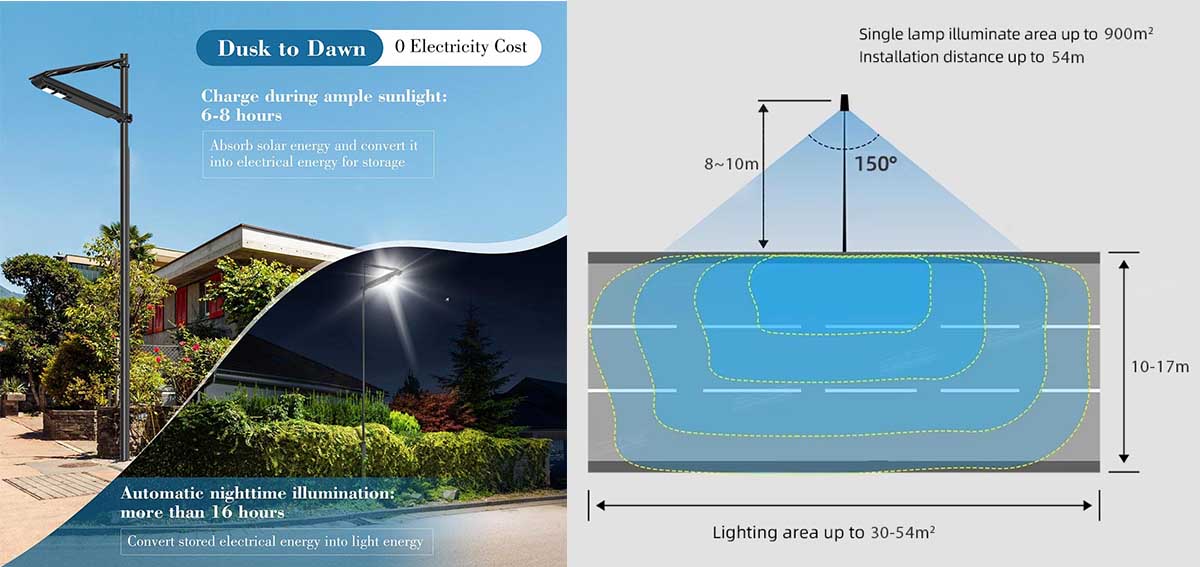
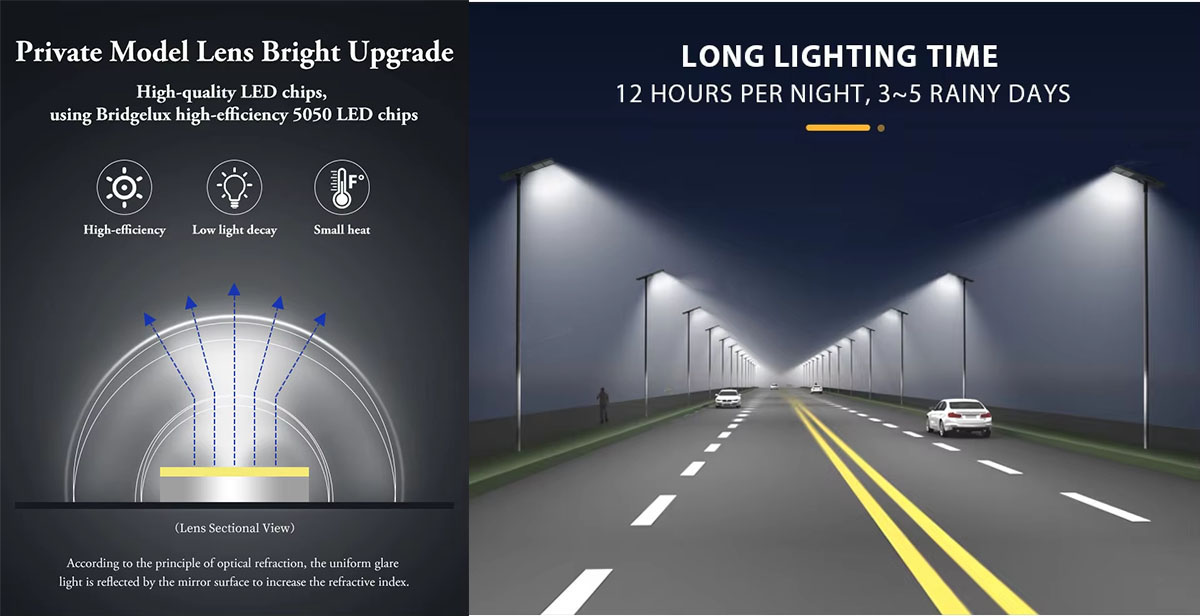
- Premium LED Chip Technology: Adopt Philips/Cree chips with 20% higher luminous efficacy than ordinary chips. Under the same power, brightness is increased by 30%, reducing the configuration cost of solar panels and batteries (especially suitable for low-light areas).
- Customized Light Distribution Design: Tailor light patterns to application scenarios—"narrow-angle high-brightness" for main roads (illuminance ≥ 20 lux) and "wide-angle uniform light distribution" for rural roads (illuminance ≥ 5 lux), avoiding light pollution and lighting blind spots.
- Anti-Glare Optimization: Use micro-prism optical lenses with a Unified Glare Rating (UGR) ≤ 19, complying with European and American road lighting standards to improve comfort for night driving and pedestrians.
- Wide Voltage Adaptability: AC/DC 12V–24V adaptive, compatible with solar panel output voltages in different regions, avoiding lighting failures caused by unstable voltage.
II. Battery Life: Extreme Environment Adaptation & Ultra-Stable Power Supply
Battery performance is the core of solar street light operation, directly determining the continuous lighting capacity in rainy days and service life. Configuration is optimized according to the climate characteristics of different regions.
1. Key Configuration & Battery Life Performance (Regional Adaptation)
| Battery Type |
Configuration Parameters |
Adapted Regions |
| Lithium Iron Phosphate Battery (LiFePO₄) |
10Ah–100Ah (12V/24V), cycle life ≥ 3,000 times |
Global universal, especially suitable for high-temperature (-20℃~60℃) and low-temperature (-30℃~50℃) areas |
| Ternary Lithium Battery (Li-ion) |
8Ah–80Ah (12V/24V), cycle life ≥ 2,000 times |
Southeast Asia, Middle East and other regions with stable temperature (10℃~45℃) |
| Gel Battery |
20Ah–150Ah (12V), cycle life ≥ 1,200 times |
Africa, South America and other regions with unstable power grids and long standby requirements |
2. Core Technologies & Pain Point Solutions
- Intelligent Battery Management System (BMS):
- Four-fold protection against overcharging, over-discharging, overheating and short circuit, extending battery life by 30%.
- Battery cell voltage balancing technology to avoid overall failure caused by single cell damage.
- Low-temperature charging preheating function (automatically activated at -20℃), solving the charging problem in frigid regions.
- High-Efficiency Energy Storage & Energy-Saving Design:
- Monocrystalline silicon solar panels with conversion efficiency ≥ 23%, enabling efficient charging even in cloudy/overcast weak light environments.
- Battery capacity redundancy design (actual capacity ≥ 105% of the rated value) to cope with extreme rainy weather.
- Combined with intelligent dimming function, battery life can be extended by 2–3 days (e.g., automatically reduce power by 50% after 12 PM at night).
- Durability & Safety Assurance:
- IP67 waterproof battery compartment, corrosion and leakage proof (essential for coastal/rainy areas).
- No memory effect, supporting deep discharge (depth of discharge ≥ 80%) without regular activation.
- Compliant with IEC 62619 international standards and UN 38.3 transportation certification (no worries for international logistics).
III. Intelligent Functions: Efficiency Improvement & High-End Market Empowerment
Intelligent functions are the key to differentiating high-end products from basic ones, and are highly valued in European, American and smart city projects. They can significantly reduce operation and maintenance costs while improving user experience.
1. Core Intelligent Modules (Market Hierarchical Configuration)
| Function Module |
High-End Configuration (Europe, America & Smart Cities) |
Basic Configuration (Emerging Markets) |
Customer Value |
| Intelligent Dimming System |
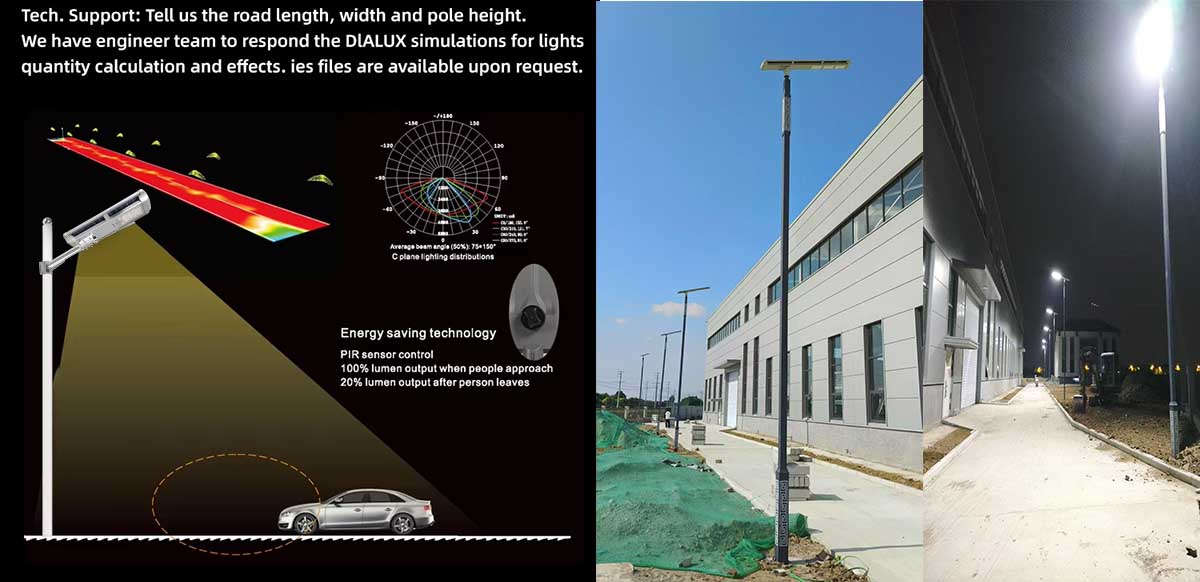
Light sensor + human/vehicle motion sensor + timing dimming:
1. Auto-on at dusk (adjustable light sensor threshold)
2. 100% power when people/vehicles approach; 30% power after leaving
3. Customizable dimming curve (APP setting) |
Light sensor + timing dimming:
1. Auto-on/off according to ambient light
2. Fixed power reduction at midnight |
Reduce energy consumption by 30–50%; extend battery life by 2–3 days; avoid light waste |
| Remote Monitoring & Management |
Cloud platform + mobile APP remote control:
1. Real-time monitoring of voltage, current, remaining power
2. Fault alarm (automatic push to maintenance personnel)
3. Batch parameter adjustment (no on-site operation required) |
No remote function; manual on-site debugging |
Realize unmanned operation and maintenance; reduce maintenance costs by 40%; shorten fault response time |
| Motion Sensor Linkage |
Microwave radar sensor (detection distance 10–15m, angle 120°)
Auto-brightness enhancement when detecting moving targets |
Optional passive infrared (PIR) sensor (short detection distance) |
Improve lighting security in rural roads/parks; balance energy saving and lighting demand |
| Data Analysis & Optimization |
Record charging/discharging data, lighting time, fault frequency
Generate operation report to optimize lighting strategy |
No data recording function |
Provide data support for subsequent project optimization; meet the data management needs of municipal projects |
2. Market Adaptation Tips
- Europe & America Market: Focus on remote monitoring, anti-glare dimming and energy consumption data statistics to meet the management needs of smart cities and green building certification (LEED).
- Africa Market: Prioritize motion sensor linkage and low-power standby mode to adapt to low-light conditions and reduce battery loss.
- Southeast Asia Market: Add typhoon-resistant wind speed monitoring (optional) to automatically adjust working mode in extreme weather and avoid equipment damage.
IV. Competitive Advantages for International Markets
1. Standard Compliance: Lighting indicators meet EU EN 13201 and UL standards; battery complies with IEC 62619 and UN 38.3, removing trade barriers.
2. Regional Adaptation: Differentiated configuration of lighting, battery and intelligent functions for Europe, America, Africa and Southeast Asia, matching local climate and application scenarios.
3. Cost Efficiency: High luminous efficacy LED and BMS battery protection reduce the total cost of ownership (TCO); intelligent functions save 30–50% of operation and maintenance costs.






 IPv6 network supported.